


Hi folks,
A procedure is a subprogram that performs a specific action. This feature is extremely important and vastly that we can use when developing in PL/SQL. Before invoking a procedure, you must declare and define it. You can either declare it first (with procedure_declaration) and then define it later in the same block, subprogram, or package (with procedure_definition) or declare and define it at the same time (with procedure_definition).
Syntax
create or replace procedure <Name> (<parameter list>)
as
  --local variable declaration
begin
   --code section
exceptions --optional
  --handlers
end;
Example 1
The following procedure is a quite simple example and it is responsible for inserting new registers to the log table. The file create_table_it_tutorial_log create_table_it_tutorial_log
Procedure
CREATE OR REPLACE
PROCEDURE p_insert_log (p_descr_log varchar2) AS

   v_new_id number;

BEGIN

  select nvl(max(id), 0) + 1 into v_new_id from it_tutorial_log;

  insert into it_tutorial_log (id, descr_log, date_log, user_log) values (v_new_id, p_descr_log, sysdate, user);

END p_insert_log;
Execution
DECLARE
  P_DESCR_LOG VARCHAR2(200);
BEGIN

  P_DESCR_LOG := 'FIRST PROCEDURE TEST';

  P_INSERT_LOG( P_DESCR_LOG );

END;
Example 2 – Adding exception handling
For more details about exception handling please check out my post below
Procedure
create or replace
PROCEDURE p_insert_log (p_descr_log varchar2,
                        p_msg_return OUT varchar2) AS

   v_new_id NUMBER;
   v_local_except EXCEPTION;
   v_error_msg VARCHAR2(255);


BEGIN

  select nvl(max(id), 0) + 1 into v_new_id from it_tutorial_log;

  IF NVL(p_descr_log, 'N') = 'N' THEN
     v_error_msg := 'The description is a required column!';
     raise v_local_except;
  END IF;

  insert into it_tutorial_log (id, descr_log, date_log, user_log) values (v_new_id, p_descr_log, sysdate, user);

EXCEPTION
   WHEN v_local_except THEN
       p_msg_return := 'Program: p_insert_log - Error: ' || v_error_msg;

END p_insert_log;
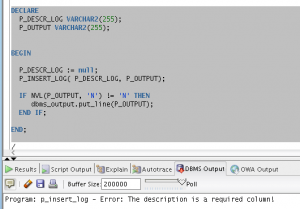
Execution
DECLARE
   P_DESCR_LOG VARCHAR2(255);
   P_OUTPUT VARCHAR2(255);
BEGIN
   P_DESCR_LOG := null;
   P_INSERT_LOG( P_DESCR_LOG, P_OUTPUT);

   IF NVL(P_OUTPUT, 'N') != 'N' THEN
      dbms_output.put_line(P_OUTPUT);
   END IF;
END;

This post is part of a series about the most common structures in PL/SQL. You can check the rest of them in the link below.
Please write down in the comments any further questions you may have. I’ll be happy to help you.